
IELTS vocabulary course
IELTS Grammar and Vocabulary for a Higher Band: What to Learn First
Build grammar control first, then connect topic vocabulary and collocations to sentence patterns that transfer into IELTS Writing and Speaking while supporting Reading and Listening accuracy.
 Grammar controlVocabulary transfer
What to Learn First
A higher-band language plan should reduce error risk before it chases rare words.
Why Random Grammar and Vocabulary Study Fails
Most learners begin by opening a giant word list or grammar book and studying whatever looks advanced. That can feel productive, but it often creates visible notebook progress and invisible test progress.
The problem is sequencing.
IELTS rewards language that is accurate under pressure and relevant to the task. It does not give extra value for broad study that never becomes controllable output. For a higher band, start with stable grammar control before expanding topic vocabulary, then test phrase-level accuracy and widen range only after the language works in real answers. This turns vocabulary into reusable modules and grammar into a system you can apply.
A useful IELTS vocabulary course is a working loop, not a word dump. Learn a point, use it, correct it, and bring it back in a new task until it transfers without notes.

Grammar and Vocabulary Work Together
Strong words still lose marks when article use or sentence logic is unstable. Preposition and noun-group errors add more risk, even when the vocabulary choice itself is strong. Grammar rules also have limited value if the answer sounds repetitive because natural phrase patterns are hard to retrieve.
The baseline is joint control. Grammar reduces risk while vocabulary adds meaning depth. Collocations make wording more natural, and sentence control keeps the whole answer stable.
The First Learning Sequence
Use this order when your goal is higher-band stability rather than passive recognition.
Stabilize grammar
Fix sentence structure, agreement, articles, tense, modifiers, and linking logic first.
Build topic language
Start with frequent IELTS topics such as education, technology, health, work, and environment.
Add collocations
Learn natural word partners before chasing rare words that you cannot use accurately.
Control sentences
Practice cause, comparison, evidence, opinion, and condition patterns under task limits.
Gate new language
Only promote words and structures that work in writing, speaking, and delayed reuse.
Transfer by section
Map each unit to Writing, Speaking, Reading, and Listening so it becomes exam-ready.
Start With Grammar That Protects Meaning
If grammar still causes meaning drift, advanced vocabulary cannot compensate.
The first 4 to 8 weeks should focus on the structures that produce the largest number of real IELTS penalties. Prioritize sentence structure control and noun phrase control first. Verb phrase control comes next. Then add modifier placement and linking logic before question transformation. These practical topics decide whether your ideas stay clear.
A starter rule bank can include tense and time relation, present perfect versus past simple, finite and non-finite clauses, countability, comparatives, modal verbs, relative clauses, conditionals, passive voice, and reported speech. Add subject-verb agreement, inversion, preposition patterns, articles, and conjunction chains once the core sentence is stable. Attach each rule to IELTS output instead of studying it as an isolated grammar note: a Task 2 paragraph, a Task 1 trend sentence, a speaking answer, or a reading sentence you previously misunderstood.
Core Grammar Checks
Use these checks before expanding into more ambitious language.
Sentence structure
Subject, verb, word order, clause link.
Noun phrases
Articles, countability, quantifiers, specificity.
Verb phrases
Tense, perfect forms, modals, conditionals.
Modifier control
Adjective position, comparison, degree, adverbs.
Linking logic
One connector should show a real relationship.

Build Vocabulary Around Task Frequency
The second phase is topic-aware but bounded. Begin with education and environment, then add technology, health, society, work, migration, and housing as practice demands. Transport, food, and governance can wait until they appear often enough to justify a cluster.
Store core terms beside natural collocations and sentence stems. You do not need 100 topics; you need language that returns quickly when a prompt appears.
Learn Collocations Before Fancy Words
Many learners say they need advanced vocabulary, but IELTS rewards accuracy of combination as much as rarity. A strong word used with the wrong verb or preposition can weaken the whole sentence.
Build lexical chunks such as make progress, face challenges, undergo changes, take measures, have a significant impact, contribute to, provide evidence, play a role, and be associated with. Keep the list practical enough that you can use the phrases in a real answer.
When adding a new word, add its partners. Record verb plus noun and adjective plus noun patterns. Add noun plus noun combinations, preposition links, and one short example of use. For example, reduce emissions, economic pressure, policy reform, contribute to, and in response to all work better when stored as usable pieces. This gives immediate return because it reduces awkward phrasing and increases retrieval speed in timed writing and speaking.
Two Ways to Store Vocabulary
Keep vocabulary connected to use, not isolated definitions.

A word list with meanings only.

Words grouped with partners, frames, and reuse tasks.
Train Sentence Control Deliberately
Higher-band output does not require many long sentences. It requires sentences that hold meaning under pressure.
Practice reliable patterns for cause and result before adding comparison. Evidence lines and balanced opinion frames can come next. Add condition or implication patterns only after the base version is correct.
How Language Transfers by IELTS Section
Each new grammar-vocabulary unit should have a section use case before it enters your main study pool.
Writing output
Use new language in topic sentences, evidence lines, linking sentences, and concise conclusions.
- Avoid vocabulary you cannot place inside a paragraph without weakening coherence or grammar control.
Speaking fluency
Use short, stable frames, natural collocations, and tense control so answers stay clear under pressure.
- Practice retrieval speed before trying riskier phrases in full speaking responses.
Reading precision
Use grammar and vocabulary knowledge to identify cause, contrast, condition, tone, and reference.
- A phrase is useful when it helps reject a wrong answer, not only when you can define it.
Listening mapping
Train chunk recognition, function words, modals, and conditionals so spoken meaning is easier to map.
- Revise by meaning, not only by sound, when you miss a phrase in fast speech.
An 8-Week Grammar and Vocabulary Map
Use phases that combine accuracy, range, output, and correction.
Weeks 1-2
Stabilize sentence control, agreement, articles, tense, and 5 topic clusters.
Weeks 3-4
Add relative clauses, modal logic, cause-effect prepositions, and mixed-topic paragraphs.
Weeks 5-6
Transfer language into mock writing, speaking rehearsal, and repeated correction cycles.
Weeks 7-8
Refine weak points, use hedging accurately, and test speed under timed conditions.
Use the Input, Output, Correction, Reuse Loop
The course loop is simple: study one structure deeply, use it immediately, correct a small number of errors, and reuse it in a different topic within 48 hours.
This loop beats memorization because it links retrieval with constraint. You are not just recognizing language; you are testing whether it appears correctly when a task asks for it.
A daily micro-loop might be: learn 10 cause-effect collocations, write three short cause-effect lines, speak one 45-second explanation, correct article and tense errors, then reuse the same language in a paragraph the next day. After each loop, ask whether the language is active. If it only works while looking at your notes, it is not ready for your main output pool.
Turn Errors Into a Training Database
Without logs, grammar and vocabulary study becomes decorative.
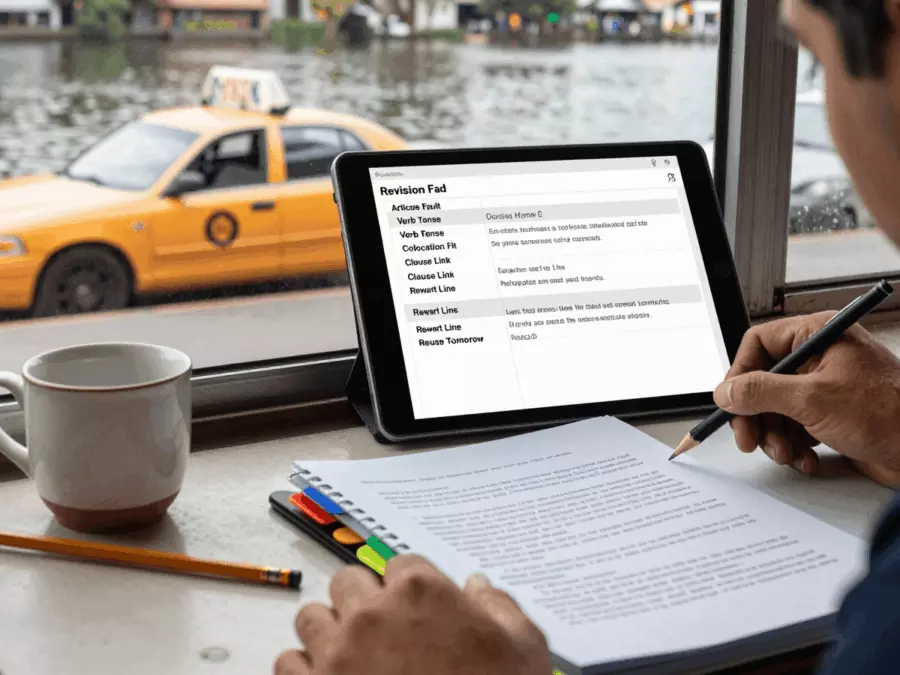
Record enough detail to retest the problem later. Keep the date, section, grammar point or vocabulary unit, error type, original sentence, corrected version, rule reminder, and next reuse task in one place.
For grammar errors, note the exact source of the problem. A tense shift should be handled differently from an article mistake. Agreement faults need their own targeted retest, not a vague reminder to be more careful.
For vocabulary errors, record the wrong combination and the corrected collocation. For example, based in may need to become based on, or make a decision in a long term may need to become make a long-term decision depending on meaning.
After 10 to 15 recorded errors in one section, choose one recurring pattern and retest only that pattern in the next two sessions.
Common Errors That Block a Higher Band
Article misuse often appears with countable nouns and general versus specific meaning. Fix it by mapping noun phrases before choosing a, an, the, or no article.
Subject-verb agreement breaks when the subject is long. Shorten the subject, find the head noun, and rebuild the sentence before final checking. Tense drift appears when learners report data or make predictions without a reference frame. For trends, decide whether the sentence is historical, ongoing, or predictive before you write.
Preposition drift weakens otherwise good vocabulary.
Store pairings such as based on, contribute to, result in, depend on, and focus on as part of the unit. Weak comparatives and overloaded links also reduce clarity. Pair comparison words with explicit anchors, and use one connector only when it changes the logic.
Before Every Study Session
Keep each session small enough to complete and correct.
Choose one grammar point
Make the accuracy target visible.
Choose one topic cluster
Limit vocabulary to useful boundaries.
Produce something
Write or speak by the end.
Retest two old errors
Review should come from your log.
Set a quality rule
Know what counts as complete.
Choose the Right Course Route After 4 to 6 Weeks
Your next course decision should follow objective signals, not anxiety.
If your error log improves, your language works in two output modes, and timing is manageable, a self-guided routine may still be enough. Choose an IELTS Online Course if your schedule is inconsistent, your logs show good targets but weak follow-through, or you need structured milestones.
Choose an IELTS Writing Course if your writing remains blocked at sentence level or paragraph level. It also helps when coherence and task-specific output keep breaking down.
Choose an IELTS Band 7 Course if your grammar and vocabulary are mostly stable but you need precision for the 6.5 to 7+ transition. Use an IELTS Writing Checker when repeated grammar and collocation errors persist across drafts. If you want a lower-pressure checkpoint before committing, start with Free IELTS Classes and test whether the sequence matches your current weak points.
A Practical 12-Week Action Plan
Stretch the same system into a realistic exam-oriented cycle.
Build clean anchors
Weeks 1-3: grammar checkpoints, topic clusters, short writing, speaking reps, and a weekly log audit.
Build topic flexibility
Weeks 4-6: add clusters, redesign one paragraph weekly, and test transfer in reading and listening.
Build speed
Weeks 7-9: use timed output, one full-task rehearsal, and revision by top error families.
Build consistency
Weeks 10-12: retest recurring errors, calibrate section drills, and decide the next course route.
IELTS Grammar and Vocabulary FAQ
Short answers for learners deciding what to study first.
Should I study IELTS grammar or vocabulary first?
Start with grammar that protects meaning, then add topic vocabulary and collocations that you can use accurately.
How many IELTS vocabulary topics should I learn first?
Begin with eight to ten frequent clusters, but keep each cluster tied to collocations, sentence stems, and output tasks.
Are advanced words necessary for Band 7?
Range helps, but accurate medium-frequency language usually improves faster than rare words used incorrectly.
How do I know a word is ready for IELTS Writing?
It is ready when you can use it in a paragraph, correct it, and reuse it later without looking at notes.
Can grammar and vocabulary help Reading and Listening?
Yes. Syntax, function words, collocations, modals, and conditionals all affect how accurately you understand meaning.
Related IELTS Study Paths
Use these next if your grammar-vocabulary system reveals a specific blocker.



Turn Language Study Into a System
The practical answer is stable: grammar accuracy first, high-frequency topic vocabulary second, collocation bundles third, sentence-control templates fourth, repeated correction fifth, and section transfer before advanced expansion.
You are not trying to show every word you know. You are trying to show the right words in the right structure in the right section at the right time.
If your baseline is still unstable, begin with Free IELTS Classes or move into the full framework through the IELTS Online Course. If writing consistency is the next blocker, use the IELTS Writing Course and the IELTS Writing Checker. For a stable learner chasing the last half-band, the IELTS Band 7 Course is the better refinement route.
Related IELTS resources
Use these links for the next preparation steps referenced in this guide.
IELTS Online Course
Continue with this related IELTS preparation step.
Open resourceIELTS Writing Course
Continue with this related IELTS preparation step.
Open resourceIELTS Band 7 Course
Continue with this related IELTS preparation step.
Open resourceIELTS Writing Checker
Continue with this related IELTS preparation step.
Open resource