IELTS exam prep
IELTS Essay Checker vs Teacher Feedback: What Actually…
Compare an IELTS essay checker and teacher feedback for real score improvement. Learn where each method works best, how to use revision loops, how to read band estimates, and how to build a Band 7…

Decision shift
Better comparison method
The page should move the reader from a vague choice to a better decision.
Choosing by label
The learner chooses based on labels, price, or anxiety.
Choosing by outcome
The learner chooses based on goal, timing, and weakness pattern.
Verdict
Best next move
Compare by fit, not hype
Best For
- Learners comparing real options
- Candidates with clear score goals
Not For
- Anyone looking for guarantees
- Readers who have not checked requirements
The real question behind the debate
Before comparing tools and teachers, define the failure mode in your writing system:
You generate lots of ideas but lose marks for weak task focus. – Your first draft sounds acceptable, but you cannot improve the second draft in a focused way. – You get inconsistent Band 6 or 6.5 results even though your vocabulary feels better. – You spend too much time revising and still miss criteria. – You improve one weakness only to discover another one is still blocking you.
When you know which failure mode is real, you can choose the right support at the right time.
A lot of people assume this is a simple either/or choice. But for most learners, it is usually a sequence:
Use automated review for fast detection of repeatable issues. 2. Use human feedback for interpretation, judgment, and nuanced development. 3. Use structured test practice to transfer both into real conditions.
That sequence is where consistency usually starts.
You do not have to buy into a perfect tool narrative or a “only teacher” mythology. You need a system where each component has a clear job.
Study workflow
Writing support should make revision visible
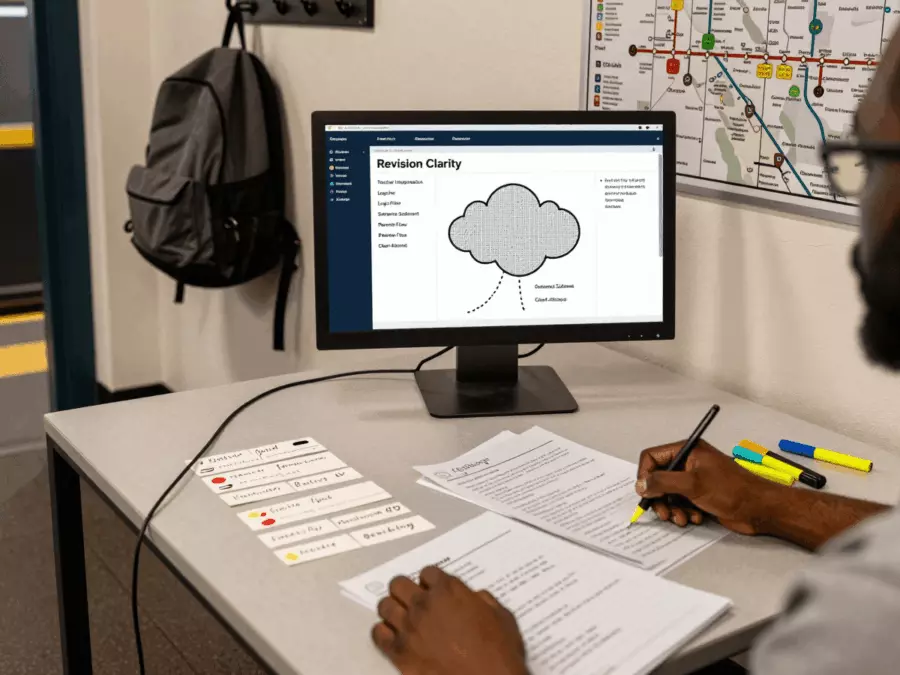
The image should show essay drafting, rubric-style review, and the shift from feedback into a better second attempt.

Why learners reach for an IELTS essay checker first
An IELTS essay checker is attractive for obvious reasons:
It is always available and gives immediate feedback. – It can process multiple drafts quickly. – It highlights recurring issues you may miss when you are tired or anxious. – It can force you to revise methodically instead of guessing.
In the first weeks, many learners gain the most from the checker because it helps them build a baseline. For example, if you repeatedly submit Task 2 essays with missing counterarguments or weak paragraph transitions, you may not need broad theory immediately. You need a system that identifies the same pattern and shows it again and again until your process changes.
When people say “an essay checker replaced my teacher,” they usually mean they enjoy convenience. But convenience is not a full learning mechanism. It is only part of one.
What an IELTS essay checker does very well
Teachers read every essay, but humans are not machines, and no teacher can give the same intensity on 30 drafts in one day.
A checker can be fed a fresh submission in seconds, and it can consistently mark recurring issues. This helps in two ways:
you can iterate multiple versions in one day, – you can test one variable at a time: “Did my topic sentence control improve?” “Did my linkers become clearer?” “Did the paragraph balance improve?”
This makes the checker ideal for high-frequency revision loops.
Pattern detection over isolated corrections
Suppose a checker flags: – repeated article errors, – several unclear pronoun references, – and one overused template-like opener.
A weak interpretation of this output is to fix three random examples. A stronger interpretation is to classify the pattern: “I am creating grammatically unstable sentences under stress” and “my paragraph opening lacks contrast logic.” That classification can drive targeted practice much better than spot corrections.
A forcing function for revision discipline
Many candidates stall after writing their first draft because they do not know what to revise first. A checker pass can turn that uncertainty into a ranked list:
fix response focus, – then structure drift, – then grammar issues that create meaning uncertainty, – then style.
This is close to the discipline needed under exam conditions.
Speed and consistency are good strengths. But an automated checker cannot replace contextual intelligence in every area:
It cannot fully judge whether your argument is ethically and logically defensible for the specific prompt. – It cannot always tell whether your example is truly persuasive in the context of the task. – It cannot fully replicate how a human examiner reads your intended tone, progression, and judgment quality. – It can misread high-level nuance and score-risk in unique prompts.
For that reason, the checker alone can accidentally encourage mechanical writing. It may make you “pass checkboxes” without strengthening your actual writing decisions.
For IELTS writing, especially Task 2, that is not enough.
What teacher feedback contributes that a checker cannot fully replicate
A teacher does what technology still does poorly: interpret your response as meaning, not just structure.
In Task 2, you are not only writing with correct sentences. You are making decisions about: – whether your first claim is balanced, – whether your counterargument is realistic, – whether your conclusion feels earned, – whether the essay reads like a coherent position or a stitched set of points.
Teachers can challenge weak assumptions. They can ask: “Why do you assume this solution is possible for both urban and rural contexts?” That kind of question is hard for automation to replace because it requires context, pragmatics, and argument strategy.
Two learners can make the same lexical mistakes but fail or pass for different reasons.
One learner may misread a “discuss both views” task as “state your opinion only.” Another may use a strong position but ignore consequences asked in the prompt.
Teacher feedback is effective because it corrects how you *interpret* tasks, not just how you express.
Development of exam judgment, not just sentence editing
A teacher can build your internal score radar by repeatedly connecting your draft to IELTS criteria: – Task Response (task alignment, addressing all parts, position clarity), – Coherence and Cohesion (paragraph logic, transitions, paragraph function), – Lexical Resource (range, precision, appropriateness), – Grammatical Range and Accuracy (control, accuracy under pressure).
With this type of coaching, you do not merely learn corrections; you learn how to reason like an examiner at the writing level.
Not every learner has the same bottlenecks.
One candidate may need sentence-level control support first. Another may need stronger critical reasoning before language refinement.
Teacher feedback allows a custom roadmap: what to learn first, what to skip this week, and what task conditions require extra rehearsal.
If you have only two essays in, a human feedback session can still be valuable. But if your revision loop needs 8-10 quick iterations in one week, the teacher may not be accessible for every draft.
Human mentorship is also expensive and bounded by availability and quality. You need planning around schedule, deadlines, and how quickly feedback is returned.
So again, it is not superior in every context. It is superior at strategic judgment, slower but deeper.
The core misunderstanding: this is not an either/or choice
The strongest students treat checker and teacher as adjacent tools, not competing products. If your plan says “I use only one,” you are usually creating a hidden bottleneck.
The realistic model is: – checker for speed + pattern detection + short-loop revision, – teacher for interpretation + judgement + direction.
You then verify transfer through timed practice.
Writing Task 2 should be the priority lens
This article compares the two methods through Task 2 first because this is where most learners see the biggest variance and also the biggest uncertainty.
Task 2 scoring depends heavily on: – thesis clarity under debate questions, – balanced argument development, – paragraph logic, – and sustained language control in a longer response.
These are areas where both support systems help, but in very different ways.
A checker helps quickly flag: – weak thesis claims, – repeated paragraph structure errors, – and unsupported “generic examples.”
It can also help you spot mechanical instability (for example, repeated sentence-level errors in the same position where you usually rush) across multiple drafts.
Task 2 strength signals from teacher feedback
A teacher helps with: – assessing if your position is coherent and believable, – testing the quality of your counterargument, – improving argument hierarchy (main claim → sub-reason → implication), – and making your conclusion feel genuinely reasoned, not formulaic.
When checker feedback is most useful in Task 2
Use it for: – high-volume drafting, – targeted error correction, – and short cycles where you need immediate visibility of what changed.
When teacher feedback is most useful in Task 2
Use it for: – ambiguous prompt types, – weak critical reasoning, – mismatched scope (“global,” “local,” or “all adults”), – and developing a stronger “author voice” that matches criteria.
Task 1 fits in, but should be introduced carefully
Because many learners prepare both tasks, this comparison must include Task 1 too. But Task 1 has different scoring emphasis and output expectations: – summarizing and selecting relevant details, – describing processes and trends, – clear graph/chart interpretation (Academic), – or structured letters for General Training task formats.
In Task 1, a checker can efficiently flag language clarity and format issues early. A teacher helps with interpretation accuracy, tone control, and avoiding overcomplicated statements that distort data meaning.
If you are currently Task 2-focused, do not lose time trying to tune every tiny Task 1 issue to the same standard as Task 2. Build separate feedback loops: – Task 2: emphasis on argument and judgement, – Task 1: emphasis on format fidelity and concise paraphrasing.
Revision loops: the practical mechanism of improvement
Most people ask whether they should improve by using checker tools or teacher feedback. The better question is: what is your revision loop?
Revision loops are the only thing that converts feedback into score gains.
Loop 1: Checker-driven micro-loop (24-hour cycle)
Use this for fast correction and repetition reduction.
Write one complete Task 2 draft in 35-40 minutes. 2. Run an automated review and copy only the three strongest issues. 3. Rewrite only one paragraph using explicit changes. 4. Run review again after 1-2 days. 5. Keep a notes log with category tags: – Task response – Coherence – Lexical choice – Grammar pattern
This loop is not about “perfecting” each draft. It is about reducing recurring failures across attempts.
Loop 2: Teacher-guided weekly loop (7-day reflection)
Use this when you need directional judgment.
Complete two essays from different prompt types (opinion and discussion). 2. Submit both to a teacher or mentor. 3. Ask for one-page guidance on the top 3 criteria risks and two improvement priorities. 4. Rebuild your next writing week from those priorities only. 5. Return with two revised drafts from one of the prior prompts.
This loop builds interpretation and reasoning quality. You are not chasing dozens of errors; you are building a method.
Loop 3: Hybrid loop (best long-term system)
This is where most learners move once they can control one cycle.
Prep sequence
The writing improvement loop
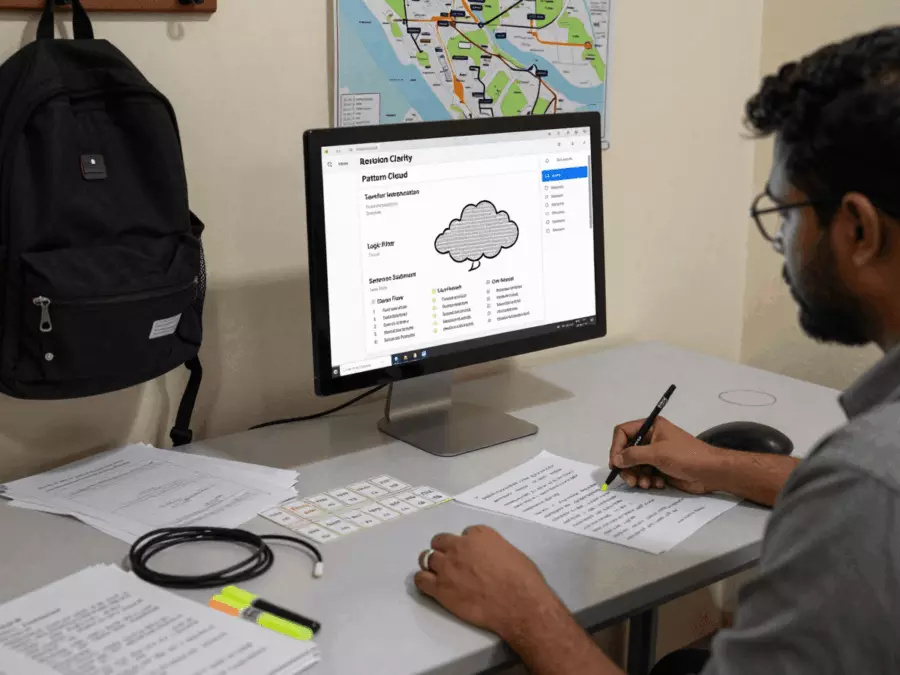
Each frame should show a different writing behavior: planning, drafting, and revising from feedback.
Monday/Tuesday: Draft + checker loop on one essay. – Wednesday: apply checker outputs and rewrite. – Thursday: second draft review by teacher. – Weekend: full timed attempt and transfer test with your improvement log.
This model gives you: – speed, – consistency, – and human-level prioritization.
How to make band estimates useful
This is one of the most misunderstood topics.
Both free and paid scoring tools often provide a band estimate. The estimate is useful if interpreted correctly. It becomes harmful when treated as an official score card.
Use estimates as a directional signal with three checks:
Did the estimate improve because your task response changed, or because you replaced short phrases?
If the gain disappears in your next timed attempt, it is likely surface-level.
Can your improvement stay under time pressure in a fresh prompt?
If you only improve on the exact topic you practiced, your estimate is probably not representative.
Did the same weakness disappear in two or three later drafts?
If it appears again, the score estimate was probably reflecting temporary fluency, not stable change.
When you apply these checks, the “band estimate” becomes a training indicator, not a result. That distinction is crucial.
The best way to combine tool output and teacher notes
Most people receive feedback in scattered formats and then do little with it.
An effective process should include a single “revision map” document with: – issue category, – evidence from draft, – chosen intervention, – and retest task date.
Issue: task drift in discussion prompts – Source: teacher feedback – Evidence: first paragraph does not answer “discuss both sides” in prompt 2 – Intervention: use one-sentence constraint summary before drafting – Retest: next Thursday timed Task 2
The same method works with checker output:
Issue: repeated “firstly/furthermore” pattern with no real transition logic – Source: checker pattern report – Intervention: replace with relationship logic (contrast, cause/effect, concession) – Retest: same prompt revised, new one as transfer test
This is why many learners improve faster with fewer interventions: they are no longer deciding at random.
A practical decision framework
Not every learner should choose the same setup immediately. Use this framework to decide where to invest:
Start with a checker to build baseline habits: – quick submission, – frequent short revisions, – clear error categories.
Then add teacher support only when your first bottleneck is argument logic, not language mechanics.
You may already use a checker efficiently and still feel stuck.
At this stage, teacher feedback usually gives more return: – precision of task interpretation, – stronger claim hierarchy, – improved nuance and coherence.
You likely need structured external review at least once every 7-10 days, plus checker-driven daily drafting.
Use a hybrid model by default: – checker for recurring weakness tracking, – teacher for criteria reasoning and high-level coaching, – periodic practice tests for transfer.
The goal is not to add one extra essay every day; it is to make each correction transferable.
Use a two-track approach: – one checker-based micro loop on 2-3 key error types per week, – one teacher mini-session each week focused on argument depth and scoring criteria.
This preserves quality while keeping schedule realistic.
The Band 7 path: task interpretation, precision, transfer
If you are targeting Band 7, you need to think beyond grammar perfection.
Band 7 writing quality often comes from improved control across conditions: – you can hold a position in 10 minutes, – you can sustain paragraph logic over 280-320 words, – you can avoid task drift under time pressure, – you can revise with purpose.
Below is a practical path built around this goal.
Stage 1 (Weeks 1-2): diagnostic stability
Your objective is not to “get better fast.” It is to define your pattern map with precision.
Complete 3-4 Task 2 essays with checker-supported drafts. – Record one teacher-reviewed essay per week. – Focus categories: – thesis clarity – paragraph function – cause/effect vs opinion support – response timing – Create a revision rulebook with 5 high-frequency problems.
At the end of week 2, you should know exactly where your consistency fails.
Stage 2 (Weeks 3-4): argument depth and judgeability
Add one teacher checkpoint every 1-2 weeks. – Build counterargument handling in every essay, even when not required. – Practice “position precision”: one thesis, three supporting routes, one qualification. – Use checker only after your human-reviewed map is applied, so automation stays focused.
This stage reduces abstract language without improving logical control.
This is the stage many people skip and then wonder why their practice test scores stay flat.
Do full 40-minute timed Task 2 attempts. – Before each attempt, write one-line thesis and one-line proof plan. – After each attempt, review with checker tags and one teacher comment set. – Test transfer by changing topic type: policy, technology, education, family, environment.
Transfer success means your process survives topic shifts.
Stage 4 (Weeks 7-8): consolidation and stabilization
Reduce number of issues targeted at once. – Prioritize consistency over perfection. – Aim to keep all four criteria improvements visible for at least two attempts. – Use periodic IELTS practice tests or full section simulations to check timing and scoring stability.
If you can maintain your score band across conditions, you are not merely memorizing; you are building competence.
Revision planning with examples (Task 2 focus)
Here is what a balanced weekly routine can look like with both support systems.
Monday: Draft essay from Discussion prompt using one-line thesis + two supporting reasons. – Tuesday: Checker review + category tags. – Wednesday: Rewrite using top 2 tagged issues only. – Thursday: Teacher review session on one revised draft. – Friday: Implement two recommendations across a fresh prompt. – Saturday: Timed attempt to test transfer. – Sunday: Rest and short error-log cleanup.
That rhythm matters more than writing one long essay each day without review depth.
Because each day targets one layer: – mechanical correction, – strategic revision, – transfer application.
You stop piling random knowledge and start building transfer loops.
What to ask a teacher so your time is never wasted
Not all teacher feedback is equally actionable. To avoid vague responses, ask for structured prompts:
“Which IELTS criteria is the most blocking one this week?” 2. “What is one paragraph function I should fix first?” 3. “What is one pattern in my writing that always returns under time pressure?” 4. “What is the smallest rewrite pattern I can do this week?”
Good feedback gives specific behavior changes. Weak feedback says “sounds better” or “needs better vocabulary” without mapping to criteria.
If you do not get specificity, your teacher review becomes less useful than a disciplined checker loop.
What to ask an IELTS essay checker so it is genuinely useful
When using a checker, avoid “all issues at once.” Set a narrow objective:
“Focus on task response and coherence this session.” – “Show me repeated grammatical patterns, not one-off corrections.” – “Give only high-impact sentence-level risk and logic drift indicators.”
If your tool has tag categories, map them to your current focus. If it does not, make your own short rubric before each run.
By guiding the tool, you prevent a common problem: turning automation into random correction noise.
Common mistakes that block improvement
Treating band estimates as final scores and stopping early. – Applying every checker suggestion at once, which hides your next true priority. – Using teacher comments as absolute truth without retesting. – Ignoring timed transfer conditions and assuming untimed clarity will hold. – Assuming IELTS writing improves only from vocabulary, then neglecting task interpretation and structure.
How this decision shifts with schedule and budget
If you have unlimited review time, you can use a deep teacher cycle. If you have limited time, your system should be more mechanical and measurable.
But even in limited budgets, you still need strategic human input. Without it, automation can produce clean drafts that are still misaligned with task judgment.
Here is a practical minimum viable feedback stack:
Checker: 3-5 times weekly for targeted micro-revisions. – Teacher: biweekly or weekly for argument-level coaching. – Practice test blocks: at least once every 10 days for transfer checks.
This is often more effective than random full support.
How to evaluate a support setup after one month
After 4 weeks, evaluate with three measurable questions:
Has your revision process become faster and clearer? 2. Are your task misunderstandings decreasing? 3. Do your best-practice attempts transfer to different prompts?
If at least two are true, your model is working.
If all three are false, re-balance: – More teacher checkpoints if your interpretation is weak. – More checker cycles if revision is slow. – More timed practice if transfer is missing.
Common candidate profiles and recommended stack
Profile A: Newer learner with grammar anxiety
Recommendation: – use checker for frequent corrections, – one short weekly mentoring session, – then weekly full-task practice.
This usually stabilizes Task 2 planning and grammar confidence in 3-4 weeks.
Mid-score learner and Band 6.5 to Band 7 blocker
Priority: remove score volatility and bridge remaining blockers. – maintain a tight checker cycle on high-frequency errors, – structured teacher feedback on criteria interpretation, – weekly writing course-aligned module from IELTS writing course and eventually IELTS Band 7 course.
The biggest win here is quality of revision decisions under pressure.
Integrating the writing checker with course learning
If you are already enrolled in lessons, the checker should reinforce the same rubric, not create a second language.
Start each lesson module with one writing objective. 2. Complete one checker-supported draft applying only that objective. 3. Submit a second draft for teacher review and compare alignment. 4. Convert recommendations into your next week’s learning list.
If you are building broader study momentum, a full program like an IELTS online course can help you keep these loops from breaking.
A note on quality versus volume
Many learners confuse “write a lot” with “improve a lot.”
Writing volume without structure is low-yield. A smaller number of intentional drafts plus clear revision rules improves more.
The winning pattern is: – one strong feedback objective, – one short revision method, – one transfer test.
What actually improves writing most
If you compare the two methods from first principles, this is the practical truth:
Automated review improves frequency of detection, not always quality of judgment. – Teacher feedback improves quality of judgment, not always revision frequency.
For IELTS, especially in Task 2, you need both.
Checker reliability is best when your goal is: – reducing repetitive errors quickly, – spotting patterns across many drafts, – building draft-level momentum.
Teacher reliability is strongest when your goal is: – interpreting Task 2 prompts correctly, – building defensible arguments, – refining judgment on criteria-based performance.
So the better metric for your decision is not “which is better,” but: > Which part of your writing system is currently weakest, and which support fixes that most directly?
Practical next step: your two-week experiment
You can validate this now with a 14-day protocol:
Week 1: use checker after each Task 2 draft and only fix top 2 categories. – Week 2: keep the same checker setup, add one teacher review and apply two recommendations across two new prompts. – End of week 2: run one timed IELTS practice tests mini-condition and compare score pattern and process reliability.
At the end, choose the support stack that made your process less random, not the stack that made your text look “prettier” only.
If your process is clearer and transfer is improving, you now have the right balance.
Final call
If your writing still feels chaotic, this is not a tool problem alone. It is usually a system problem.
Choose your support stack based on your current bottleneck: – checker for speed, pattern recognition, and repetition reduction, – teacher feedback for interpretation, nuance, and strategic correction, – and repeated timed practice for transfer into real conditions.
A stable path is a structured hybrid: Task 2-first writing discipline, clear revision loops, band estimate checkpoints, and weekly transfer through timed IELTS practice tests. Then expand with IELTS writing course and IELTS Band 7 course.
Related paths
Where to go next
Use the most relevant next page instead of opening every resource at once.
Next step
Turn writing feedback into a course path
Move from one writing insight into a structured lesson path so feedback becomes repeated improvement instead of a one-off note.