Skip to content

IELTS exam prep

In-Person IELTS Classes vs Self-Paced Online IELTS Prep:…

Compare IELTS course near me against self-paced online IELTS prep with a practical decision framework on cost, schedule fit, access, writing support, practice-test use, and realistic learning…

View online course

an East Asian woman in her late 20s preparing online for In-Person IELTS Classes vs Self-Paced Online IELTS Prep: Which Should You Choose?

Decision shift

Better comparison method

The page should move the reader from a vague choice to a better decision.

Before

Choosing by label

The learner chooses based on labels, price, or anxiety.

After

Choosing by outcome

The learner chooses based on goal, timing, and weakness pattern.

Verdict

Best next move

Compare by fit, not hype

VerdictFit first

Best For

  • Learners comparing real options
  • Candidates with clear score goals

Not For

  • Anyone looking for guarantees
  • Readers who have not checked requirements

Why people ask "IELTS course near me" even if they already know online exists

Search behavior around this phrase usually reveals something important: a learner is not only comparing content. They are comparing conditions.

People often use “IELTS course near me” when they need one or more of these:

quick access after work, – a fixed timetable, – accountability pressure, – a place that feels structured, – trusted local support, – lower emotional load from remote communication, – or relief from information overload.

In many cases, these needs are about *how* learning is delivered, not *what* to learn.

When people search “IELTS classes online,” the same needs appear, but they are re-framed:

can I fit studying around family and work, – can I use short study windows, – can I pause and continue without dropping structure, – can I get affordable access to quality content and assessments, – can I avoid expensive travel and long commutes, – can I choose my own pace without waiting for campus schedules.

The same learner need set appears in both searches. The difference is which logistics they can control right now.

Step one: define your outcome before you pick format

Before deciding “near me” or online, define what a successful outcome looks like for you.

If your target is not explicit, format choice becomes a proxy for identity instead of performance.

Target band (for each section if possible), – Target date, – Weekly study blocks available, – Weakest section(s), – Current access reliability (internet, device, study space), – Whether you can be accountable without external attendance, – Budget ceiling for preparation phase, – Need for one- to two-hour short sessions or longer deep sessions.

Study workflow

A comparison should reduce the decision load

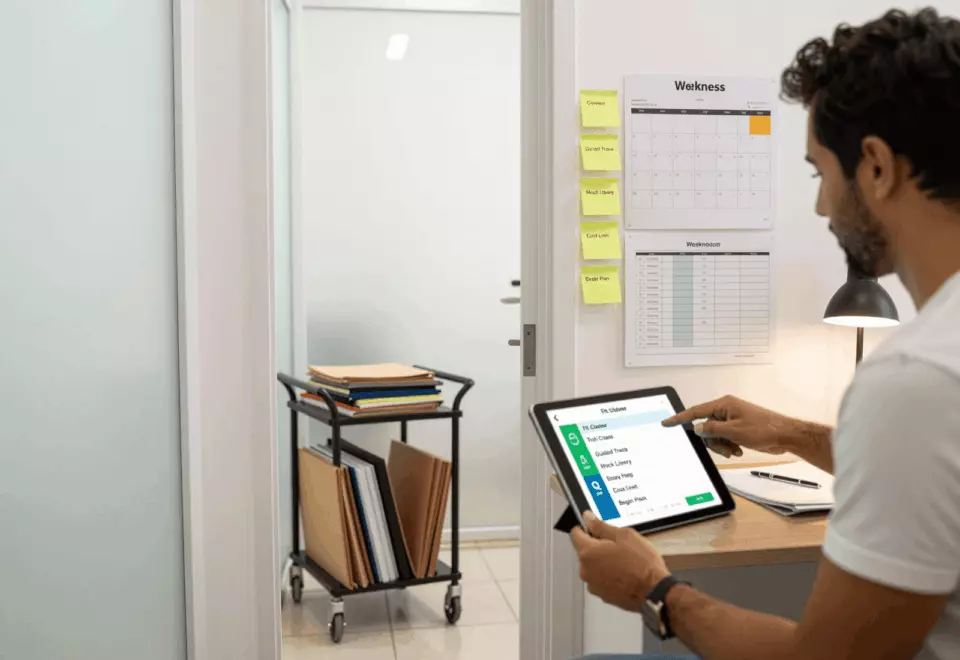
Use the visual to show a practical decision board, not a sales page: options, criteria, and a clear next action.

a white man in his early 30s reviewing an IELTS online course workflow

If you can score these clearly, you already have a decision anchor.

Most “wrong format” decisions come from treating the question as convenience vs quality. In practice it is usually about sequence and consistency.

Suppose you set Band 8 as target in 10 weeks with a full-time job. You could commit to any format, but if you cannot realistically test and review writing weekly, attend to feedback, and complete timed practice, no format will deliver.

Suppose you are targeting Band 6.5 with six months and strong discipline. In that case, a flexible system and a steady weekly schedule can outperform fixed-location classes, especially when you have room for regular self-assessment.

The goal is not format loyalty. The goal is reliable progression across the 4 sections.

What in-person classes often do better than online learning

To be fair, many learners perform better with local in-person classes than with fully self-paced systems. That can be genuine, especially if you are selecting by your behavior and environment.

Attendance lowers the activation energy

If you are waiting for the “right mood,” in-person classes remove start-up friction. You show up, class starts at a fixed time, and the learning state happens by design.

For learners who struggle with initiation, this can be decisive. Remote learners often overestimate their ability to start a session after long workdays. In-person attendance changes this equation.

Some learners improve less through content quality and more through accountability rhythm.

a fixed time creates a recurring deadline, – peers create social pressure, – teacher presence creates perceived urgency, – and momentum can carry over to homework and practice.

If your study pattern is highly irregular, this is an advantage.

Immediate questions can be solved in-context

A local class allows quick clarification loops for confusion. If you are stuck, you do not have to draft a long message and wait.

That immediate loop can reduce compounding error in reading strategy, question interpretation, and task response logic.

If your home setup is full of interruptions, commuting to a class can create a dedicated study zone. For some people that alone explains better concentration and completion rates.

Beginner learners sometimes need visible structure

Very early-stage learners can benefit from explicit pacing and visible class progression. They may not yet know how to design a study loop from scratch. In-person class designs can provide that structure sooner.

That does not mean online is weak. It means some learners need a stronger external scaffold early.

What self-paced online prep often does better than in-person

Online does not automatically mean less structured. It often means more control over your own structure.

If your life changes week to week (work shifts, caregiving, health, travel), online prep can preserve consistency better than fixed-seat classes.

You can shift study times without losing access. You can run shorter sessions on stressed days. You can restart after interruptions with immediate continuity.

Better fit for diverse learning rhythms

Most learners do not learn best in the same daily window. Self-paced formats let you align difficult sections to peak focus times (some in morning, some late night).

That adaptation matters for retention and output quality, especially for:

timed writing planning, – reading accuracy under fatigue, – listening transfer, – grammar correction cycles.

If your preparation model requires frequent testing and revision, online systems can compress cycles:

watch or read a module, – apply in a mini-task, – review and adjust immediately, – take a short test segment, – return to weakness point.

In-person classes can do this too, but scheduling limits and class pace may slow cycle speed.

With online prep you often get clearer access models: shorter commitments, lower overhead, and predictable renewal options. You are paying for learning structure, not physical infrastructure.

Cost is not the only factor, but for many learners this changes who can maintain preparation for 8-16 weeks without dropout.

Self-paced systems can integrate a broad test library quickly, plus writing and revision workflows, without requiring physical class alignment every week.

If your bottleneck is volume practice plus targeted correction, online systems are often easier to scale.

Honest comparison: where in-person is not always superior

There are reasons in-person can look strong, but still not solve your score challenge:

You can still avoid homework. – You can still misunderstand section patterns. – You can still miss reading traps. – You can still produce weak writing plans under time pressure. – You can still stall if your revision process is missing.

Physical attendance solves only a subset of learning issues. If your main blocker is error recurrence or test strategy under stress, environment matters less than method.

Conversely, online does not solve everything either:

you can drift into passive browsing, – you can watch many lessons without implementing a weekly cycle, – you can confuse active and passive completion, – you can overconsume without measurable output.

The important decision is: which format creates better conditions for your specific weakness?

Cost and schedule tradeoffs: a practical lens

It is common to compare only tuition amount, but the real total cost is larger.

class fees, – travel or parking costs, – possible printed materials, – fixed timing opportunity costs, – sometimes cancellation penalties.

subscription or course fees, – occasional platform tools, – internet and device costs (usually already owned), – but lower travel and fewer fixed timing penalties.

Schedule burden comparison

In-person classes create committed weekly blocks. That is often helpful but inflexible.

session segmentation, – catch-up planning after missed days, – integration with variable schedules.

If you frequently miss scheduled classes due to workload or family needs, online may preserve continuity.

If you struggle to begin alone, in-person may protect against drift.

Access accessability and consistency costs

“Can I begin immediately when life changes?” matters as much as tuition.

a learner with rotating shifts and unpredictable evenings may lose 2-4 in-person sessions each month. – the same learner with self-paced online access can still finish modules in short windows and keep momentum with minimal schedule disruption.

The math is not tuition only. It is the effective completion rate under your real schedule.

If budget is tight: how to compare value, not just price

Do not evaluate either format on lowest cost. Evaluate expected effective value.

How many total study hours will I realistically complete? – How many weekly correction/revision loops will happen? – How often can I verify progress with full tests and targeted sections? – What is my completion probability for 8 weeks?

In many cases, an affordable online path with high consistency beats an expensive in-person option with high missed attendance.

The opposite can also be true: if online access does not create your weekly routine, a lower-cost in-person model with strict timing may be more efficient.

What a "full course" must include, regardless of format

Whether you choose local classes or self-study, a real IELTS preparation path usually needs the same backbone:

level placement or baseline check, 2) structured section-by-section progression, 3) scheduled timed writing output, 4) regular practice tests, 5) targeted correction and revision, 6) periodic reset decisions based on data.

If these are absent, format becomes decoration.

That is where a self-paced online model can be stronger: IELTS Online Course can make progress architecture explicit and measurable from week one.

At the same time, some learners still need the external pacing of in-person for step 1-2.

What "free classes" should do before you commit

This is where many searchers get stuck. They either skip free material entirely or overinvest in it.

Use free content as a fit audit, not as the full plan.

teaching style match to your learning style, – whether lessons show a coherent path, – whether weak sections are explained as part of an exam method, – whether writing support appears in the workflow, – whether free access transitions into paid depth, – and whether the platform gives realistic section checkpoints.

For learners comparing in-person and online, Free IELTS Classes are your first reality check.

If your objective is local, free class attendance also reveals:

classroom interaction quality, – class pace, – peer engagement quality, – your ability to absorb in real time.

how clearly modules are sequenced, – whether you can resume sessions quickly, – whether you get immediate understanding or just passive watching, – if lesson depth is matched by practice tasks.

Use free content to answer “Can I learn here this week?” Not “Does this look good on a website?”

Do not confuse polished production for learning fit.

feels disconnected from paid progression, – over-indexes on motivation and skips method, – has vague progression language, – lacks section-level planning, – or has no clear step toward writing correction and retests.

Good free classes reduce uncertainty. They should make your next decision easier, not harder.

Full course vs free classes: choosing the right stage

Many people can learn meaningful material from free classes but still plateau.

start with free classes and diagnostics, – identify weak sections, – move into structured full access when self-review can no longer drive momentum alone.

This is true whether in-person or online. The difference is where the transition is easiest and less costly.

If you can stay consistent on free material for 2-4 weeks with visible progress, a staged transition helps.

If you stall after 3-5 sessions, you may need earlier access to full progression and full test routines.

Reading

Readers often improve with repeated timed exposure and error analysis. In-person can help if your main issue is lack of discipline and you need direct timing reminders.

Online can help more when your issue is availability and repetition frequency: you can complete more reading passes without travel overhead.

include diverse question types, – force evidence-based answer decisions, – repeat short passages with different strategies, – review errors by cause, not by answer label.

If your pattern is recurring misreads under fatigue, format is secondary; you need repeated controlled recovery methods.

Listening

Listening is where fatigue and consistency often diverge.

In-person sessions can make people follow focused routines, especially at the beginning. But many learners eventually need extra unsupervised repeated sessions to improve transfer.

Self-paced online platforms allow this easier if resources are structured into short cycles:

short section drills, – immediate note-taking checks, – repeated re-listens in separate windows, – targeted recovery practice.

Either way, improvement depends on method quality and routine frequency.

Writing

This is usually the loudest mismatch point in format debates.

If your writing is your lowest band and you repeatedly lose points on planning and revision, your decision should prioritize one question:

Can the format give you a weekly revision loop?

If no, in-person attendance alone is unlikely to improve scores much.

If writing is your priority, pair your path with explicit writing support:

structured writing tutorials, – error pattern tracking, – repeated timed practice, – and revision strategy.

Use the IELTS Writing Course for learners needing targeted writing mechanics and section-specific support, and the IELTS Writing Checker for fast iterative review during revision loops.

Decision sequence

How to compare without drifting

The sequence should show the learner narrowing options by evidence rather than reacting to the loudest claim.

a South Asian woman in her late 20s working through Filter
Step 1Filter

Remove choices that do not fit the learner's level or schedule.

Speaking and practical classroom dynamics

Speaking is a separate exam section with a timing and delivery pattern. Local classes can help with confidence through repeated oral exposure and direct classroom simulation. Self-paced systems can also help by integrating prompt interpretation frameworks and structured response templates that you can rehearse.

The decisive factor is not whether speaking is done in person or online. The decisive factor is whether your practice method forces full response development and post-task reflection.

Practice tests: the central decision bridge

Whether you choose online or in-person, if practice testing is not systematic, no format gives stable results.

Use the same test discipline in either case:

consistent full mocks every 2-3 weeks, – targeted section tests on weak areas weekly, – score trend logging, – question-type error annotation, – and explicit action changes between attempts.

This is where online systems often have an edge in operational ease because retests can be repeated frequently without timetable conflicts. In-person programs can still be excellent if they enforce this cadence with fixed review sessions.

For those choosing between local and online options, use these questions to decide:

How often will I get full mock review? – Is review used to set specific micro-goals? – Do I get enough writing revision opportunities between mocks? – Can I compare performance changes month to month?

The answer determines whether a format is merely convenient or truly preparatory. Use IELTS Practice Tests as the baseline resource logic for your full test design.

A practical decision framework you can use this week

You do not need perfect certainty. You need a testable hypothesis.

Stage 1: choose your current risk profile

ability to follow own schedule without reminders, – consistency history (weeks completed as planned), – tolerance for commuting, – tolerance for delayed response in questions, – comfort with self-logging and revision, – budget flexibility, – access reliability.

Writing stability under time, – Reading recovery under pressure, – Listening concentration across full session.

If schedule reliability and discipline scores are low, start with in-person support for structure. – If schedule flexibility and learning autonomy scores are moderate or high, start with self-paced online. – If both are mixed, use hybrid: online self-study + weekly accountability check-in.

The framework is not final. It is a starting hypothesis to test for 4-6 weeks.

Common mistakes in choosing "near me" or "online"

Mistake 1: believing one search term means one need

affordability, – pace, – safety, – confidence, – language anxiety, – or lack of structure.

Do not treat it as a binary format statement.

Mistake 2: overvaluing classroom presence

Presence does not automatically create deliberate practice. You can attend class yet fail to revise.

Mistake 3: overestimating self-paced flexibility

Flexibility only helps when your routine includes review routines. Without review, it becomes content consumption.

Mistake 4: thinking writing support is optional

Many learners treat writing as “manageable at the end.” In reality, writing errors and time control often determine readiness.

If writing remains weak, pick systems that integrate writing support.

Mistake 5: skipping free trial evaluation

Skipping this step often leads to expensive mismatches.

Use free access as your filter and choose by process quality.

A balanced view: when in-person can still be the best first step

We can still be honest and say in-person can be the right starting choice for some learners.

you repeatedly fail to start studies without a fixed schedule, – you need immediate teacher presence for emotional consistency, – your home environment is too chaotic, – you feel highly overwhelmed by independent planning, – you require face-to-face reassurance for early confidence.

If these are your current conditions, a local class can reduce friction in the first 4-8 weeks.

But it should still be paired with clear online-style accountability metrics:

weekly output goals, – section performance markers, – writing correction routines, – and mock-test trend review.

Without these, even a good in-person environment may not lead to strong IELTS gains.

A balanced view: when online is the stronger option

you have unpredictable schedules, – you need lower cost entry and clearer cost predictability, – you learn better from recorded/repeatable content, – you want frequent testing and revision loops, – you want full control over study intensity per week, – you are willing to self-manage with a structured timetable.

Online can also be better when you are trying to sustain preparation through travel or changing time commitments.

This does not mean you “self-teach.” It means you design a system and run it with the same seriousness as a scheduled class.

Our online setup supports this by emphasizing structure, free entry points, and ongoing section improvement paths through writing and test practice.

Building your own hybrid model (if both options feel incomplete)

Many learners do best with a hybrid system, especially in the transition from confusion to consistency.

online self-study in the mornings for reading/listening modules, – weekly writing revision cycle, – optional local accountability session (group study, mentor check-in, study partner), – full tests on fixed weekends.

flexibility of online, – accountability from human check-ins, – and reduced dropout risk.

The key is to avoid random toggling. A hybrid should still have a single weekly loop and clear section targets.

Example: mapping profiles to format recommendations

Profile 1: Full-time employee, unstable schedule, weak Writing

Likely fit: self-paced online with strong revision framework.

schedule volatility makes fixed attendance risky, – writing weakness needs frequent short revision loops, – online practice can be sliced around available energy windows, – can still escalate into focused writing support quickly.

How to decide when no one format feels right

If you feel unable to choose between modes, run a 4-week diagnostic comparison.

complete free classes, – follow weekly study plan, – run two section mocks and one full simulation, – apply writing revision once weekly, – track completion and trend.

Option B: 4 weeks local class with review

attend sessions for same number of weeks, – maintain the same number of study sessions outside class, – compare completion rate and transfer to mock sections.

Choose the option with stronger trend stability, not stronger impressions.

This is a disciplined way to avoid format bias and choose based on your own data.

Decision rubric: 12 questions to settle it quickly

Can I follow a weekly schedule without external reminders? 2. Can I complete 90 minutes of focused study without supervision? 3. Can I maintain writing output for two weeks in a row? 4. Do I track errors after mock tests? 5. Do I revise writing using a clear checklist? 6. Do I return to a weak section immediately after failure? 7. Can I tolerate delayed teacher response? 8. Is commute time a recurring stress or drain? 9. Can I learn in short sessions (40-60 minutes)? 10. Can I keep a study log consistently? 11. Is budget a major constraint for long-term access? 12. Do I need live correction for confidence?

If No is common in 1,2,3,4,5,6,10, online with structure is still possible but will require strict personal systems.

If No is common in 7,9,10,12, the in-person environment may support stronger immediate follow-through initially.

Use your results to pick one mode first, then re-evaluate every 4 weeks.

How to avoid comparing on price alone

Before spending on any option, estimate your cost per completed meaningful hour.

Meaningful hour = completed study + meaningful reflection + applied test review.

You can complete many hours of viewing content without meaningful progress. That hour should be treated differently from productive work.

If you can maintain productive hours consistently, a lower per-hour investment often compounds into stronger outcomes.

Why full writing support matters in both modes

You can still pass baseline checks without writing support, but improvement toward target band is usually slower without structured correction.

Writing under time is a separate challenge from writing after reading notes. It combines task interpretation, organization, and time control.

If your article path prioritizes writing:

keep periodic writing review cycles as non-negotiable, – track one writing weakness per cycle, – retest after revision, not after a random rewrite, – measure improvement across section prompts.

This is where combining a full course with a review layer helps.

If writing is your main blocker, guide readers toward IELTS Writing Course and IELTS Writing Checker where appropriate.

Final decision, stated plainly

If you need local structure, accountability, and immediate in-class support, in-person can be very useful in early stages.

If you need flexibility, cost control, and repeatable self-directed practice with full test-review loops, self-paced online prep is often the stronger match.

Since we do not offer local in-person classes, our practical recommendation is to evaluate your pattern against an online-first approach with high structure:

begin with free classes, – move into full course progression where needed, – integrate practice testing consistently, – use writing-specific support early if writing is your limiting section.

That is the most scalable path for learners who need both integrity and flexibility.

The best IELTS decision is not the one with the strongest marketing promise. It is the one that survives your real week, week after week, until your mock scores and timed performance improve.

Compare by usable progress

A course decision should be judged by usable progress, not by the longest feature list. The right choice gives the learner a realistic schedule, enough access to revisit weak lessons, clear writing support, and a way to measure whether study is transferring. If a cheaper option creates confusion, it can become expensive in time. If a paid option does not change weekly behavior, it is not good value.

Next step

Choose the IELTS prep route that fits

After comparing the options, start with free classes or the online course path that best fits the learner's schedule and target.

View online course

a white man in his early 30s choosing the next IELTS prep step online