IELTS exam prep
IELTS Writing Task 2 Course Guide: Essays, Ideas, Structure,…
A practical IELTS Writing Task 2 course guide that breaks down prompt analysis, idea selection, paragraph logic, thesis control, coherence, lexical resource, grammar, timing, revision, and Band…

Decision guide
How to use this article
Read this as a practical decision page, then move to the core course page that matches your need.
Workflow
Writing improvement loop
Use a repeatable sequence so preparation turns into measurable progress.
1. Analyze task
Read the prompt for purpose, format, and score criteria.
2. Draft under timing
Write with a repeatable structure, not open-ended effort.
3. Review criteria
Check task response, coherence, vocabulary, and grammar.
4. Rewrite one weakness
Revise the one issue most likely to change the next attempt.
Action list
Use this before the next step
A short checklist keeps the page practical instead of theoretical.
Know your goal
Define the score and route before study volume.
Use the right page
Move to the linked core page that matches the need.
Measure progress
Retest only after focused revision.
Avoid guarantees
Treat improvement as a system, not a promise.
Why a Task 2-specific route is useful
Task 1 and Task 2 look like writing tasks, but they test different muscles. Task 1 rewards accurate summarizing and clear format discipline. Task 2 rewards argument quality, controlled development, and a balance between logic and language. Trying to prepare both together can work, but many learners stall because they do not yet have a stable scaffold for one task type.
A dedicated Task 2 course narrows that problem by giving you:
a repeatable prompt analysis method you can apply in less than 90 seconds, – a core idea engine for choosing stronger arguments quickly, – paragraph templates that preserve coherence even when ideas are rough, – and a scoring map tied to IELTS criteria, not generic writing advice.
That is why this guide is written as a practical system rather than a grammar-only checklist.
The same path is useful if you are aiming for a reliable jump to Band 7. High scores in Task 2 are less about “fancy phrases” and more about consistent control in all four scoring bands: Task Response, Coherence & Cohesion, Lexical Resource, and Grammatical Range & Accuracy.
Study workflow
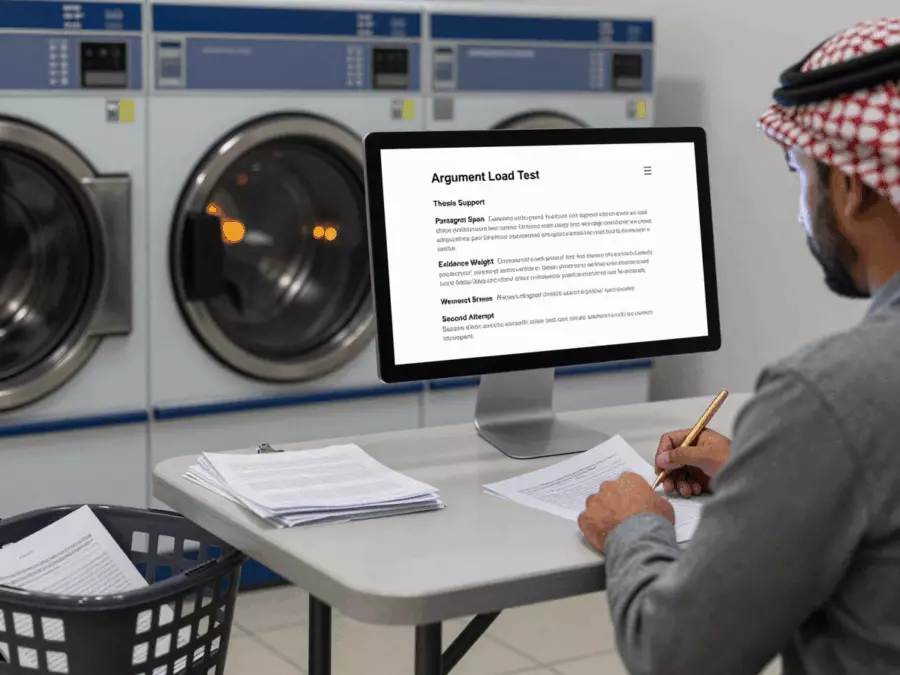
Writing support should make revision visible
The image should show essay drafting, rubric-style review, and the shift from feedback into a better second attempt.

What this guide covers
This is a writing-first article. It focuses on the mechanics of scoring in IELTS Writing Task 2.
We will cover: – How to decode question types in under two minutes, – how to select ideas that are easy to defend under pressure, – how to keep thesis and paragraph logic connected, – how to control cohesion without connector stuffing, – how to choose vocabulary that sounds natural and relevant, – how to reduce grammar errors while building complexity over time, – how to schedule study and testing with a realistic time plan, – how to use a writing checker as part of a feedback loop (not a replacement for your judgment), – and a concrete Band 7 pathway with checkpoints.
If you are the kind of learner who improves most when everything is actionable, this structure will feel familiar: short principle, clear drill, measurable checkpoint.
The first rule of Task 2 success: read for constraints
Most Task 2 losses come from weak prompt interpretation. You can write beautiful language, but if you miss the task type or constraints, your score drops quickly.
Before you write a sentence, answer four questions:
What is the task asking for? 2. What is the exact action requested? 3. Which perspective should I adopt? 4. How many viewpoints does the question require?
Use a quick CARS template: Command – Angle – Requirements – Scope.
Command: Is it *discuss both views*, *do you agree or disagree*, *to what extent*, *is it beneficial*, *is it true*? – Angle: Is the question asking for social impact, policy recommendation, ethical evaluation, or personal responsibility? – Requirements: Does it ask for examples, reasons, solutions, alternatives, or consequences? – Scope: Is the context global, local, student-level, adult workers, governments, families, education systems?
This takes 45-90 seconds but prevents many avoidable errors.
Use this classification while practicing:
“Discuss both views and give your opinion” – Requirement: balanced overview + clear standpoint. – “Do you agree or disagree?” – Requirement: clear position; counterpoints are optional but useful for nuance. – “To what extent…” – Requirement: calibrated argument with nuance, not absolute statements. – “What are the causes/effects…” – “Are there solutions?” – “Evaluate…” – Requirement: judgment and criteria.
If you confuse these, you either produce too generic an essay or miss required counter-arguments. In a course context, this is where many learners should spend their first 1-2 weeks.
Prompt conversion: from question to testable question
After CARS, rewrite the prompt into one line:
> “I am arguing that [position], because [reason]. I will show [scope], then [limitations], then [result].”
If you cannot say this in one sentence, your plan is not ready to draft.
Essay planning in real exam conditions
The highest-yield planning strategy for Task 2 is not perfection; it is coherence under time pressure.
Line 1: Question claim One sentence that captures the task demand and your stance.
Line 2: Thesis Your central response for the essay. This is the argument your entire response should support.
Lines 3-4: Body route Two paragraph arguments that each contain: – claim, – explanation, – example or logic, – mini-link to the thesis.
Line 5: Counterpoint and resolution One sentence showing awareness of limitations and your final balancing position.
This planning method works well because it forces you to decide the logic sequence before writing. It reduces weak first paragraphs and wandering topic sentences.
Minute 0-3: CARS analysis + one-line thesis. – Minute 4-7: build 2-3 body points and one counterpoint. – Minute 8-30: draft introduction and main paragraphs. – Minute 31-34: add optional counterpoint paragraph or integrate counterargument within bodies. – Minute 35-38: read once for coherence and criteria alignment. – Minute 39-40: quick grammar and error patch only where clear.
That gives you a repeatable base. As you improve, you may shift 2-3 minutes between drafting and revision, but the sequence should stay stable.
Idea development: from weak ideas to defendable ideas
Many learners collect ideas quickly but cannot turn them into evidence. A Task 2 course needs an idea system that converts thought into usable argument quickly.
Build a reusable idea bank in three categories:
Human-centered: behavior, incentives, stress, fairness, habits. 2. Institution-centered: policy, schools, technology, governments, companies. 3. Long-term perspective: environment, social change, education quality, digital habits.
Do not write every idea as full detail. Use compact entries:
Claim, – Why it matters, – one practical example, – one risk.
Claim: “Online learning increases flexibility.” – Why: lets learners study around jobs and family obligations. – Example: shift-work students can continue learning at night. – Risk: weaker peer interaction without structure.
Such entries are easier to retrieve under stress than full paragraphs.
Relevance: does it directly answer the question? – Proof-ability: can I justify it with common knowledge/logic? – Specificity: is it clear enough for one paragraph? – Balance: does the essay need a competing view? – Depth: can I explain causes and impacts without overclaiming?
Weak ideas fail these filters and should stay out of your essay. This also lowers the chance of repeating the same generic point.
Thesis and paragraph logic
Your thesis is not just a statement of opinion. In Task 2 scoring, it is the control line for paragraph logic.
Can every paragraph point support this thesis? – Can a reader predict your main stance from paragraph 1? – Does your thesis avoid overclaiming?
Weak: “I think social media is bad for students because it causes many problems.” Better: “Social media can improve communication and education access for students, but strict digital discipline is needed to protect learning quality and well-being.”
Better theses are: – specific, – measurable, – naturally open to balanced treatment.
each paragraph has one function, – each body builds on the previous paragraph, – transitions should signal relationships, not decorate lines.
Paragraph 1: main claim and mechanism, – Paragraph 2: secondary claim with contrasting condition, – Paragraph 3: counterargument and realistic limitation, – Conclusion: synthesis with practical final position.
Each paragraph should answer: “If this point is removed, does the essay lose its direction?” If yes, keep. If no, cut or merge.
The role of paragraph shape
A simple paragraph framework helps prevent rambling.
Topic sentence: clear claim in one sentence. – Explanation: expand the claim with logic. – Mini-example: short scenario, statistic type, or concrete case. – Link: restate relevance to thesis.
This is not rigid, but if every body follows this, your cohesion naturally improves.
For Coherence and Cohesion, IELTS examiners respond strongly to: – clear paragraph purpose, – clear progression, – controlled transitions, – no abrupt topic jumps.
You can compensate for a less ambitious vocabulary list if your logic is strong.
Four essay question formats and the best structure choice
Task 2 prompts usually cluster into recurring styles. In a writing-first course, each style uses a stable base structure but with slightly different emphasis.
Introduce both sides, – weigh relative impact, – conclude with judgment based on reasoning.
This format should avoid fake neutrality. The examiners do not reward avoiding a clear opinion; they reward clear evaluation.
define where the advantage appears, – identify context-limits, – explain disadvantage and trade-off, – synthesize balanced conclusion.
early clear thesis, – strong supporting reasons, – one major limitation to show depth, – conclusion that reinforces the position.
define the issue with social context, – explain one direct intervention, – explain one implementation barrier, – conclude with realistic improvement conditions.
Prep sequence
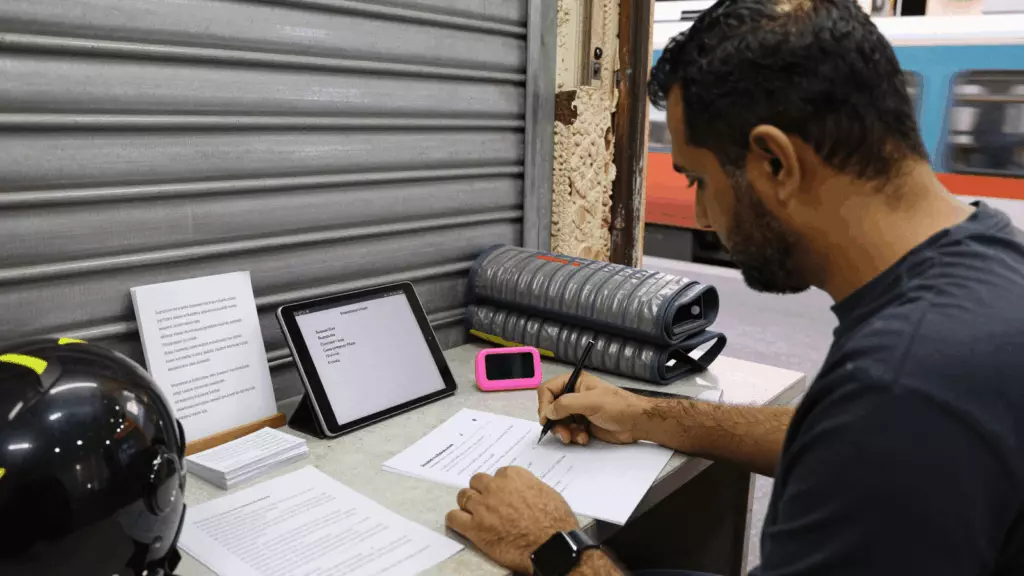
The writing improvement loop
Each frame should show a different writing behavior: planning, drafting, and revising from feedback.
This template is less about list-style “problem one, problem two”; it is about coherence and feasibility.
Grammar strategy: complexity through control, not decoration
Band improvement is often blocked by unstable grammar in longer sentences. You can increase complexity safely by controlling two things:
one complex structure you can use repeatedly, 2. one accuracy guardrail you check every draft.
Concession + contrast “While some argue X, it is important to recognize Y.” – Conditional reasoning “If policies are implemented without local support, results are unlikely to sustain.” – Embedded explanation “This is particularly significant because it affects …” – Nominalization (carefully used) “The expansion of remote learning” instead of repeated verbs.
verb tense consistency within each paragraph, – subject-verb agreement on complex subjects, – article use in key nouns, – punctuation around introductory clauses, – pronoun reference clarity.
Do not overcorrect beyond what you can verify. If you start fixing everything at once, you introduce more risk. Pick one sentence pattern and stabilize it across 3-4 drafts first.
Lexical resource and phrase bank: use range without sounding artificial
Many learners chase memorized lists but lose naturalness. A better path is a two-layer vocabulary system:
Core functional vocabulary: transition, cause/effect, social and educational lexis used accurately. – Issue-specific vocabulary: terms tied to the topic (for example, regulation, access, accountability, sustainability).
Contrast: however, while, yet, despite, in contrast. – Degree: significantly, increasingly, marginally, broadly. – Cause/effect: leads to, results in, contributes to, makes it possible/impossible. – Qualification: however, although, nonetheless, this suggests that, in many cases.
“It can be considered that…” (over-formal, heavy)
“Many people accept this because…” – “In practice, this often happens because…”
Scorers value precise, natural language more than dense phrase stacking.
Also, avoid repeating one phrase family in every paragraph. Repetition can flatten style and hurt coherence. The goal is controlled variation.
Cohesion: connectors are tools, not decoration
If your paragraphs are logically sequenced, overusing connectors actually hurts.
Opening relationship: first, initially, in many contexts – Progressive logic: furthermore, as a result, therefore – Contrast/limitation: however, on the other hand, although – Conclusion: overall, in sum, ultimately
Keep these as verbs of logic, not decorative noise.
Start each body with one clear claim sentence. – Do not mix two different claims in one paragraph. – Use pronouns only when antecedent is obvious. – Use repetition of 1-2 keywords to maintain topic continuity.
If you need fewer words for the same meaning, keep one shorter sentence with one clear link. Clarity beats complexity.
Common coherence errors learners make
You start with one stance and then imply opposite in the conclusion. Fix: write a one-line thesis and verify every body sentence supports it.
One paragraph includes unrelated points (e.g., education reform and online behavior in same paragraph). Fix: split into separate paragraphs or drop weaker point.
Conclusion repeats introduction without synthesis. Fix: include a synthesis line with implications, not repetition.
Overloaded chain like “moreover, however, in addition, therefore” in one paragraph. Fix: remove at least half; keep one connector per logic step.
Using “on the other hand” to start a supporting example. Fix: use “for instance” for examples and “however” only for contrast.
Each correction has one purpose: reduce ambiguity.
Task response with high scoring alignment
Task Response is where many essays fail despite decent language. The criterion rewards a clear answer that addresses all parts, supports claims, and shows reasoning.
does this answer part of the question directly? – do I explain a mechanism, not just claim? – do I show why this matters for the topic?
If your paragraphs describe scenarios without analysis, your score remains average.
Use the “claim + mechanism + implication” cycle:
Claim: digital learning increases flexibility. – Mechanism: learners can fit study around work, reducing dropouts. – Implication: long-term skill development can continue for wider populations.
This cycle is exam-ready because it moves from opinion to argument.
Timed practice: from knowledge to reliable execution
You improve faster when practice has explicit cycles rather than random writing. Build weekly structure and keep your timing fixed.
Mon: one full timed essay + one diagnostic from CARS. – Tue: idea generation drill + two paragraph development only. – Wed: rewrite previous essay with stronger transitions and one grammar focus. – Thu: practice one “discuss both views” prompt under 40 minutes. – Fri: one timed essay + checker pass and error tagging. – Sat: focused correction day; rewrite one paragraph from scratch. – Sun: one full reflection and 5-minute planning drill only.
The rule is consistency beats volume. If you run this sequence for 4 weeks, your response speed and structure stability generally become more reliable than with 7 random essays per week.
start time to finished draft, – start to revision, – number of words, – whether thesis was completed before minute 8, – number of major structure edits.
Use this to identify if your bottleneck is planning, writing, or revision.
Writing checker use without dependency
Tools can be helpful when used correctly. For a Task 2 course, a checker is one layer in a loop:
Draft essay under test timing. 2. Mark the first pass for meaning and criteria compliance. 3. Run checker only for language support and repeat-error identification. 4. Choose one category to revise (e.g., logic, coherence, grammar, or word choice). 5. Rewrite with purpose. 6. Reassess against criteria manually.
This avoids the trap of rewriting the essay from checker output.
In practice, pair checker use with a category log:
Task Response issues found – Cohesion issues found – Lexical issues – Grammar issues
If one category repeats week after week, assign a focused micro-drill to that category the next session.
It is usually strong for repeated grammar patterns, overuse of words, and sentence-level repetition.
It cannot fully evaluate argument quality, prompt interpretation, or real exam feasibility under stress. Those are your planning and coaching checkpoints.
This is why the guide pairs checker use with a live IELTS writing checker workflow rather than replacing reading and rewriting discipline.
Revision protocol: 15-minute rewrite method
Revision is where many candidates lose the gains from good planning. Use a stable revision framework:
Is the thesis clear and positioned in line 1-2? – Does each paragraph directly support the thesis? – Did introduction and conclusion match in scope?
Are all question parts addressed? – Are examples relevant and concise? – Are transitions logical?
fix tense mismatch, – fix pronoun ambiguity, – fix major punctuation errors.
remove repetition, – remove over-ornamented or unnatural phrases, – tighten one sentence where needed.
Each pass should have one objective. Do not polish everything at once.
Common mistakes that block Band 7 progress
A strong claim with vague support does not hold. Instead of “People use technology often,” use context-based specificity: “Students in cities using home internet typically attend online lessons at least twice a week, while others face access limits.”
If your essay says “This is a major issue” without boundaries, examiners cannot reward depth.
Abstract words without mechanism reduce clarity. Use cause-effect links to ground ideas.
A valid response usually includes judgment. Balance is not the same as neutrality.
Introduction that only restates prompt wording loses point. Reframe and take a position.
Band 7 pathway: what to do week by week
Moving to Band 7 in Task 2 usually requires disciplined consistency in all criteria. This is a realistic sequence:
100% prompt parsing accuracy in 90 seconds. – Stable thesis sentence. – Clean first paragraph pattern.
each paragraph contains explicit mechanism + example. – counterargument handled once with control. – fewer weak claims and unsupported generalizations.
cleaner paragraph transitions. – reduced repetition of unsupported phrases. – stronger conclusion tied to task wording and body logic.
Weeks 7-8: Raise lexical and grammar control
controlled complex structures used without rising error rate. – better precision in tone and register. – fewer sentence fragmentation errors.
at least 3 full timed essays/week using IELTS practice tests. – periodic benchmark analysis across the four criteria. – specific improvement log by criterion.
2-week performance review on all weaknesses. – rewrite one essay from a lower-band version using improved version. – decide whether you are ready to move to IELTS Band 7 course support.
Do not skip the review checkpoint phase. If you jump from drafting to testing without correction cycles, your gains become random.
Why timing mistakes hurt more than language flaws
In Task 2, late-stage panic creates avoidable errors. If your structure is unfinished by minute 25, grammar and vocabulary degrade.
Prioritize: – a strong opening plan, – complete all three body units before polishing language, – then finish with a focused proof scan.
That order usually improves quality and reduces last-minute mistakes.
Linking Task 2 course with broader study
Once stable, connect this module to the full writing pathway:
Continue this module for ongoing writing volume, – Integrate other modules through IELTS writing course for complete coordination, – Move into IELTS Band 7 course when your baseline is stable but score jump requires finer criterion optimization, – keep using check cycles with IELTS writing checker for repeatability, – run periodic full mock conditions through IELTS practice tests to measure transfer.
If you learn best in self-paced sessions, this module also fits well inside a broader IELTS online course structure with weekly milestones.
Final 10-day launch plan
If you want an immediate start, use this exact schedule:
read and classify 5 prompts using CARS, – build one thesis template for each command word.
write 2 timed essays, – apply paragraph template and one coherence revision pass.
add one counterargument exercise each day, – use a writing checker and track only one error category.
attempt 2 additional timed essays, – compare against your own previous writing, not random samples.
run a benchmark with one mock exam session, – update your error log and choose your next 10-day cycle.
This is an execution plan, not theory. Keep the loop tight and you will quickly know what is stable and what still needs repeated correction.
Weekly checkpoints after Task 2 mastery
In week 2 and again in week 4, decide your next move:
continue this [IELTS Writing Task 2 course] in a longer cycle if your thesis and paragraph logic still drift, – move to IELTS writing course if format control is stable and you need broader writing integration, – use IELTS online course style modules for routine if you need stronger consistency, – switch to IELTS Band 7 course when your criterion scores become stable but you want tighter Band 7-level calibration.
Closing synthesis
An effective IELTS Writing Task 2 course builds results by reducing uncertainty in the first 10-12 minutes and improving logic control in the last 10. If your opening, paragraph shape, and thesis control are stable, your essays stop drifting. If your revision is tied to a criteria checklist, your quality becomes repeatable.
The highest impact move is simple: write the prompt first as a decision, then write the essay as a proof of that decision.
That sounds basic because it is the discipline that separates random effort from real score progress. Master this and you have a practical path toward strong Task Response, cleaner cohesion, stronger lexical use, controlled grammar, and a realistic Band 7 trajectory.
Use writing evidence, not hope
The safest way to improve IELTS Writing Task 2 course is to make every written attempt produce evidence. A useful draft should show what the task demanded, how the answer was organized, which language errors repeated, and what changed in the rewrite. That evidence gives the writing course and checker a real job: they help identify patterns, but the learner still needs to revise one weakness at a time and test the change under timing.
Move from feedback to transfer
Feedback is valuable only when it transfers into the next attempt. After a checker result or lesson note, choose one scoring criterion and rewrite a small section before writing a full response again. This keeps writing improvement focused and prevents the learner from collecting comments without changing exam behavior.
Related paths
Where to go next
Use the most relevant next page instead of opening every resource at once.
Next step
Turn writing feedback into a course path
Move from one writing insight into a structured lesson path so feedback becomes repeated improvement instead of a one-off note.